Articles in this Volume

Research Article Open Access
Research about the Correlation Between Attachment Style of Chinese Young People and AI Romance Willingness
With the rapid development of artificial intelligence (AI), the research findings suggest that users may form romantic relationship with AI and the individuals with varying attachment styles may turn to AI as a substitute to obtain emotional fulfillment typically derived from human relationships. However, few studies have explored why users fall in love with AI. Therefore, this research collect data based on Chinese Adaption of Experiences in Close Relationship Scale (ECR) and online questionnaire. Using the Pearson correlations analysis, the study determines the connection between AI romance willingness and attachment types. The study's findings indicate a strong positive relationship between AI romance willingness and the degree of attachment anxiety or attachment avoidance. AI romance willingness is positively correlated with an individual's attachment avoidance and anxiety levels. The result not only broadens the explanatory scope of the attachment theory but also provides certain feasibility for AI virtual lovers. However the study neither compared AI romance willingness across secure, anxious and avoidant attachment groups, nor employed a sample with sufficient representativeness to support the generalizable conclusions.
Show more
Read Article PDF
Cite
Research Article Open Access
Affective Trajectories and Learning Outcomes in Russian Language Learning among Chinese-English Bilingual Learners Using Personalized AI Learning Software
Article thumbnail
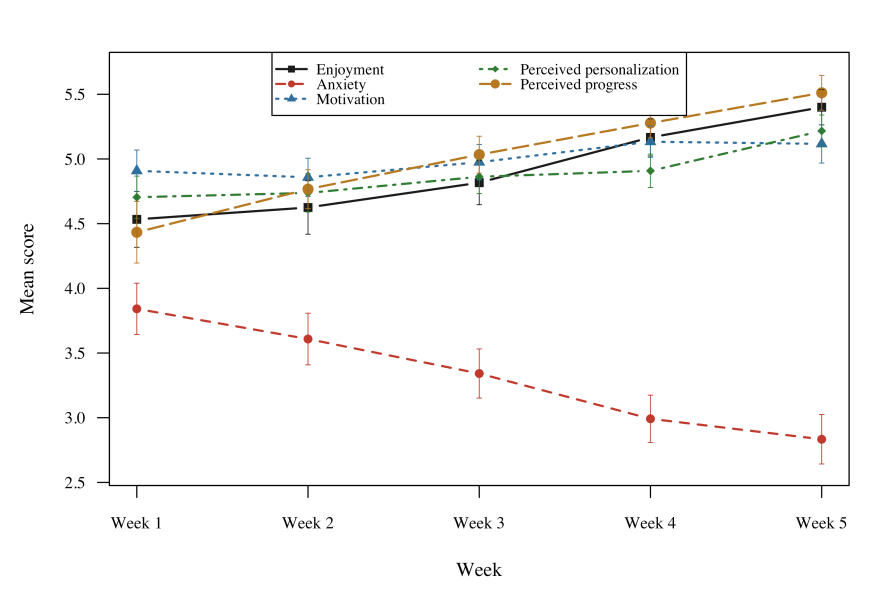
Generative artificial intelligence (GenAI) is entering the field of language learning. However, longitudinal evidence remains limited for Chinese-English bilingual learners studying a third language such as Russian. This study examines affective trajectories and learning outcomes in foreign language learning supported by personalized AI software. A four-week longitudinal pilot study followed 30 Chinese-English bilingual learners as they used a personalized AI application to learn Russian. Weekly questionnaires measured enjoyment, anxiety, motivation, perceived personalization, and perceived progress, and a Russian test was administered at the end of the study. The results showed that, during AI-supported learning, learners' anxiety declined, enjoyment and perceived progress increased, perceived personalization rose slightly, and motivation remained stable. Multilevel models showed that perceived personalization was associated with a faster decline in anxiety (interaction term = -0.178, p < .001), and this result remained robust after baseline anxiety was controlled. These findings suggest that visible personalization in AI-supported early L3 learning may function less as a direct route to short-term achievement and more as an affective support mechanism, especially for anxiety reduction. The study provides practical evidence for third-language teaching and for the design of AI-based educational tools that attend to learners' emotional experience.
Show more
Read Article PDF
Cite
Research Article Open Access
The Neural Basis of Emotion Regulation: A Review of Prefrontal-Limbic Mechanisms and Their Implications for Psychotherapy
Emotion regulation involves the strategies by which people adjust the strength, time course, or display of emotional responses. This review integrates psychological theory, functional neuroimaging, meta-analytic evidence, and intervention studies to characterize the neurocognitive basis for emotion regulation,which emerges from dynamic interactions among distributed brain networks. Regulation depends on context-sensitive activity in the amygdala, insula, and cingulate cortex during emotion generation, whereas intentional control engages lateral and medial prefrontal regions that maintain goals, interpret events, and shift attention or meaning. Effective regulation therefore relies on information integration rather than the inhibition of one brain region by another. Depression and anxiety involve maladaptive regulation patterns and ineffective prefrontal-limbic interaction, although these alterations are heterogeneous and non-specific to particular diagnoses. Cognitive behavioral therapy, exposure therapy, and mindfulness-based interventions may alter appraisals, salience, self-referential processing, and neural connectivity. However, small samples, heterogeneous tasks, and the correlational nature of functional imaging constrain causal and clinical inference. Future work should adopt integrated, longitudinal, multimodal, and ecologically valid designs to identify individual-level predictors of treatment outcomel.
Show more
Read Article PDF
Cite
Research Article Open Access
How do Personal Characteristics of Home-Visitor Influence the Acceptance of In-Home Parenting Intervention in Rural China ?— A Case Study of the "REACH China" Project in Southwest China
The effectiveness of early childhood development (ECD) interventions in rural areas depends not only on the scientific rigor of the program but also on the acceptance and sustained participation of the target households. This study, using the "REACH China" project implemented in Bijie, located in the Wumeng Mountain area of Southwest China, explores how the personal characteristics of local female home-visitor influence the acceptance of in-home parenting guidance services in the context of ECD practice. Addressing the gap in existing research concerning individual traits of home-visitor, this paper adopts perspectives from relationship marketing and diffusion of innovations theories, employing a mixed-methods approach combining questionnaires and semi-structured interviews. The findings indicate that the home-visitors' "local embeddedness" facilitates initial trust-building and ensures service accessibility, while personal parenting experience serves as a beneficial factor for establishing initial trust. However, long-term trust is more dependent on professional competence and service outcomes. Personal reputation within the community emerges as a key driver for the project's diffusion, primarily built upon perceived child development progress. The influence of factors like dialect communication and familiarity with local customs, however, is lower than anticipated. This research provides empirical evidence for optimizing the recruitment, training, and management strategies of home-visitor in similar projects to enhance service coverage. It also offers interdisciplinary insights for community-based promotion models from a "client-centered" perspective.
Show more
Read Article PDF
Cite
Research Article Open Access
Generative Artificial Intelligence in Secondary Education: Learning Support, Challenges, and Educational Equity
Generative artificial intelligence (AI) is entering the field of secondary education through dialogue systems, content generation tools, and AI-supported learning platforms. Therefore, this paper reviews the application of Generative AI in teaching and learning, the associated risks, and the conditions for schools to achieve fair and responsible integration. In particular, it synthesizes peer-reviewed research in areas such as large language models, personalized school teaching, conversational teaching, assessment, academic integrity, and educational inequality, and combines international and Chinese policy guidance. Existing evidence shows that Generative AI can provide differentiated explanations, rapid feedback, various forms of learning resources, and support for curriculum preparation and assessment design. However, these benefits depend on how Generative AI is used. Errors and bias in AI output, privacy risks, academic misconduct, overreliance on AI, uneven teacher preparation, and unequal access to resources can weaken learning outcomes or widen existing gaps. On this basis, the findings support a teaching-first, people-centered approach. Teachers should retain professional judgment, while students should verify and critically assess AI outputs. Assessments should consider both learning processes and outcomes, and schools should provide safe tools and targeted support. In this context, fairness means more than access to AI tools, and students also need meaningful opportunities to develop AI literacy and use Generative AI for learning.
Show more
Read Article PDF
Cite
Research Article Open Access
Seeking Support in Non-kin Informal Relationships: An IPA Study of University Students' Experiences
University students often turn to close others within their social networks for support when experiencing emotional difficulties, but less is known about how a particular supporter is selected and how supportive interactions develop. This study explored how university students seek and experience non-kin informal support for self-identified emotional difficulties. Twelve University College London students aged 21–25 completed semi-structured interviews. Data were analysed using Interpretative Phenomenological Analysis, and three Group Experiential Themes were identified. First, participants drew on accumulated knowledge of particular relationships and considered who was likely to understand the specific difficulty when deciding whom to approach, while immediate accessibility sometimes prompted supporter involvement before a deliberate selection had been made. Second, identifying a suitable supporter did not remove participants' hesitation about disclosure. Concerns about burdening others, indebtedness, or judgement influenced whether and how much they shared. Previous interactions could make disclosure feel less uncertain, while in some cases the supporter created an opening by noticing or asking about the participant's difficulty. Third, responses felt especially supportive usually involved experiences of being witnessed, having emotions validated, and perceiving genuine care, and the perceived meaning of a response sometimes mattered beyond its practical content. The overall findings suggest that non-kin informal support develops through relationship-specific processes across supporter selection, disclosure, and the interpretation of subsequent interactions.
Show more
Read Article PDF
Cite