Articles in this Volume

Research Article Open Access
From Subject-Based to Integrated: A Comparative Study on the Implementation Practice of the 2011 and 2022 Versions of the Compulsory Education Art Curriculum Standards
The 2011 Compulsory Education Music Curriculum Standard and the 2022 Compulsory Education Art Curriculum Standard are two important guiding documents in the field of art education at China's compulsory education stage. Focusing on frontline teaching practice, this paper systematically compares the practical forms, realistic difficulties, and response strategies of the two versions of curriculum standards in the process of implementation. The 2011 version takes subject-based teaching as the basic framework, and in practice faces problems such as "teaching the textbook," single evaluation, and the divergence of urban and rural resources; the 2022 version incorporates music into the comprehensive art curriculum system, and in implementation faces new challenges in terms of teachers' comprehensive competencies, supporting resources, and diversified evaluation. The problems of the two versions of curriculum standards in the four dimensions of teaching staff, resources, evaluation, and training are in the same line and have been upgraded to some extent, reflecting a certain gap between the text of the curriculum standards and teaching practice. The effective implementation of curriculum standards does not depend only on the text design itself; it also calls for the coordinated follow-up of supporting mechanisms such as teacher cultivation, resource guarantee, evaluation tools, and research and training systems.
Show more
Read Article PDF
Cite
Research Article Open Access
How Career Development Programs Shape Career Decision-Making among University Students: A Systematic Review of Process Mechanisms
Article thumbnail
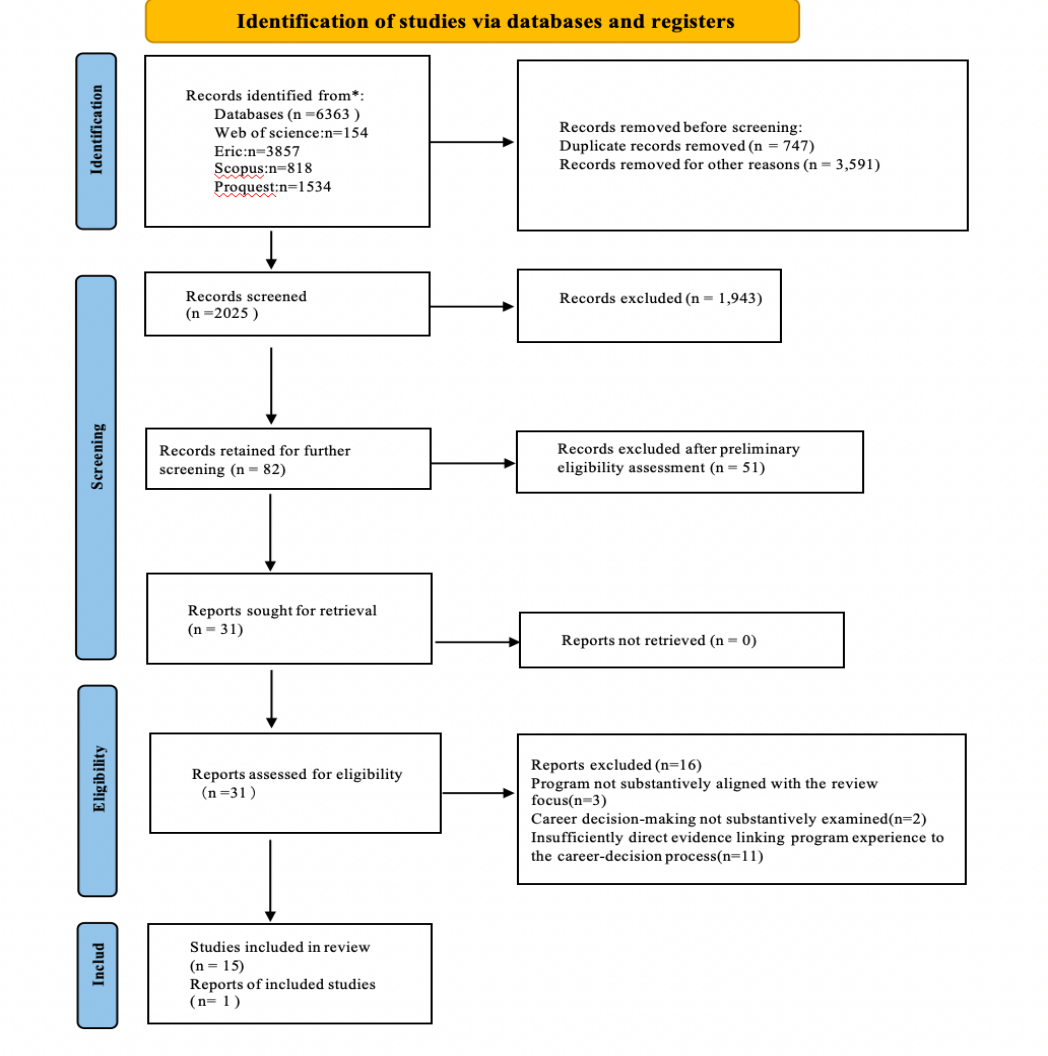
Career development programs are utilized in higher education to help university students explore and make career decisions. Evidence of how program experiences relate to career decisions has been reported in a number of studies concerning changes in self-efficacy, readiness, and other outcomes, but this evidence is quite spread out. This systematic review was conducted by synthesizing studies found in Web of Science, ERIC, Scopus, and ProQuest from 2017–2026 and documented using PRISMA 2020. A total of 15 studies were included. In different categories of programs, the synthesis revealed five recurring processes: self-understanding and reflection, career exposure and reality testing, career-related self-efficacy, relational support and career knowledge and decision processing. Results indicate that career decisions evolve as students engage in learning experiences, experiment with career options, and seek out support and information. In regard to university career development practice, the review suggests that connecting reflection, occupational experience and guided decision making is more important than provision of information.
Show more
Read Article PDF
Cite
Research Article Open Access
A Review of International Experiences in Adolescent Sexuality Education and Practical Implications for China
Sexuality education in China remains fragmented and unevenly implemented, despite adolescents' need for accurate information, skills to make consent, and access to support. Existing studies commonly examine areas alone: such as, curriculum, teachers, parents, or policy; this leaves limited guidance on how those factors may interact with each other in real context. Hence, this review analyses international cases and experiences of comprehensive sexuality education, identifying certain practical implications of those for China under the lens of ecological system theory. Through reviewing international and Chinese literature, together with UNESCO paper, this review covers certain aspects of implementation of sexuality education: curriculum design, delivery, teacher preparation, parental engagement, community support, and governmental policy. The review therefore indicates that the effectiveness CSE depend on several circumstances, in which should be age appropriate, progressive, participatory, and delivered by trained educators under the support from school-family-community network. Regarding the practical implications for China, the future practice could identify transferable experiences and adapt them to local needs, institutional capacity, and cultural conditions.
Show more
Read Article PDF
Cite
Research Article Open Access
Finding the "Right Path" of Vocational Education: A Comparison Between China and European Countries
Nowadays, global economy is developing rapidly. Fast technological iteration boosts the transforming and upgrading of industries. The popularization of higher education in recent decades leads to a surge in the number of graduates with certificates. Various factors result in the fiercely competitive labor market today. As a consequence, unemployment has become a widespread difficulty faced by a large number of young people worldwide. In this case, vocational education has gradually become an effective way to relieve this problem and ensure sustainable economic growth. This article will discuss the social and systematical causes of the marginalization of vocational education in China. It will also compare Chinese system with two typical European vocational education patterns, apprenticeship in Denmark and dual system in Germany, in an attempt to find an ideal and relatively complete vocational education systems to deal with youth unemployment across societies. This article mainly uses comparative research method to analyze the differences between education systems. Several overall practical suggestions of improvement of vocational education system are also given.
Show more
Read Article PDF
Cite
Research Article Open Access
Change of Mind Through Priming: An Empirical Study of How Future-Oriented Decision-Making is Influenced by Planning
Article thumbnail
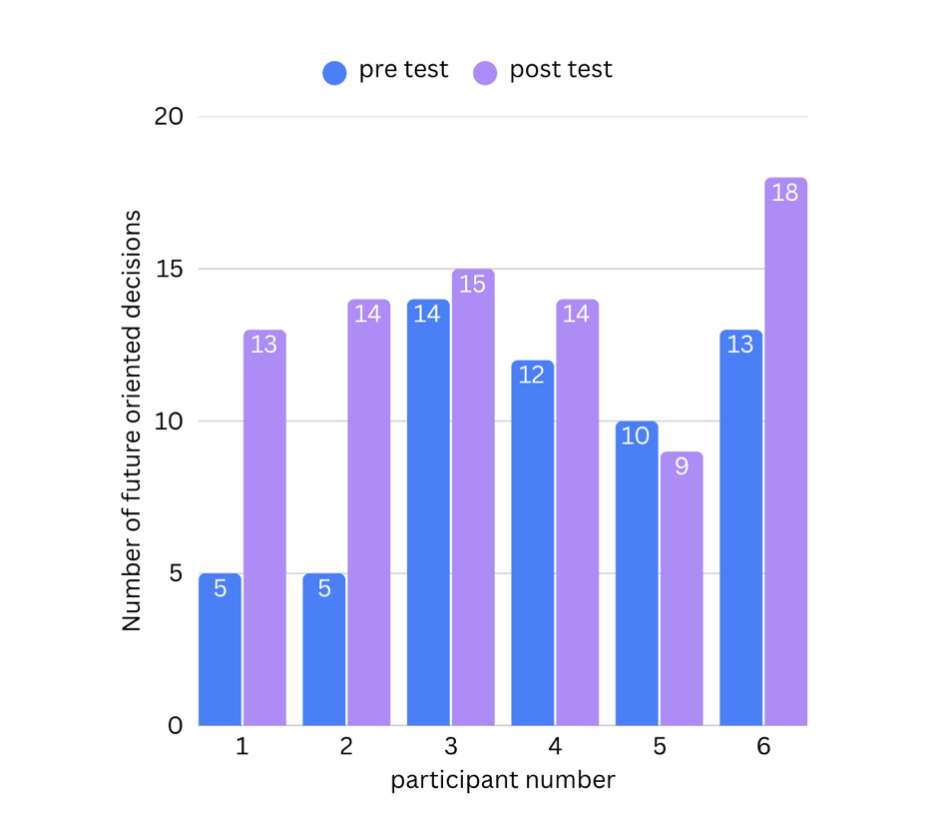
People often make decisions based on both immediate needs and possible future consequences. This study investigates whether future-oriented priming can influence decision-making. Thinking about future consequences is essential because many everyday decisions can affect a person's future. Six participants aged 27–29 took part in the study. They completed 18 everyday decision-making situations before and after the intervention, encouraging the participants to think about their future selves and long-term consequences. Five participants were more future focused after the intervention. One participant showed a slight decrease. The amount of change differed among participants and decision-making domains. Some participants changed more in long term planning, emotion, spending, sleep or attention. These results suggest that priming for the future may influence decision-making. It may increase the salience of future consequences in decision making. However, the scenarios may not fully reflect real-life decisions either. Future research could use more participants and more realistic everyday scenarios. In general, the results support the idea that future-oriented priming can influence future-oriented decision making.
Show more
Read Article PDF
Cite
Research Article Open Access
Formally Neutral Dress Codes and Substantive Equality for Religious and Cultural Minorities: An Equality Law Perspective
In modern times, countries generally no longer issue explicit dress codes targeting specific groups, but instead widely adopt seemingly neutral dress codes in public institutions. Such policies claim to apply uniformly to all citizens, yet they often bring about real conflicts for religious and cultural minorities who require special clothing for their own identities. This article takes seemingly neutral dress codes as the research object, explores the tensions between formal equality and substantive equality, and compares the dress‑related predicaments faced by minority groups in the contexts of China and Western countries. The research employs methods such as comparative study, case analysis and literature review to distill the differentiated adverse consequences brought about by facially neutral dress codes. The research conclusion holds that formal fairness at the textual level does not equal true equality. When evaluating dress codes, one should not merely look at the literal meaning but also take into account the actual situation of minority groups. Only by balancing the demands of public order with the cultural and religious dress codes can society achieve inclusive substantive equality.
Show more
Read Article PDF
Cite
Research Article Open Access
The Construction of "Professionalism": The Illusion of Formal Equality in Workplace Dress Code Regulations
Professional dress codes, ostensibly impartial standards of professional appearance, often function as instruments for reproducing class and identity discipline. This paper takes three judicial cases as its starting point: Chastity Jones's braided hair case and Jespersen's makeup case in the United States, and the disputes surrounding the BFOQ defense and religious headscarf regulation. By comparing relevant judicial precedents in the United States and Europe, it examines how these developments bear on the construction of China's domestic anti-discrimination framework. Methodologically, the paper combines case analysis and comparative research with contextual analysis, drawing on Ford's research on the history of dress codes and Bourdieu's theory of cultural capital. Existing research indicates that uniform dress requirements, while seemingly neutral, can in fact compel marginalized groups to abandon their inherent identity in order to secure access to the workplace. In China, this area has largely fallen into a legal vacuum, where compliance has been elevated to the status of professional ethical norms. Establishing a robust anti-discrimination framework in China requires drawing on the essence of the U.S. substantive equality review paradigm, while remaining vigilant against the risk of equating professional dress codes with Western business attire, and critically examining the underlying logic of domestic customs and compliance practices.
Show more
Read Article PDF
Cite
Research Article Open Access
From Formal Prohibition to Substantive Protection: The Evolution of U.S. Employment Law on Gender Discrimination
A September 2026 lawsuit alleging that Amazon denied reasonable accommodations to pregnant workers prompted my interest in the gap between legal protection and workplace practice. Although Amazon denies the allegations, the dispute raises a broader question: how far has U.S. employment law progressed in providing meaningful protection against workplace gender discrimination? This paper examines the evolution of United States employment law in addressing gender discrimination through three dimensions: hiring and recruitment, workplace sexual harassment, and pregnancy and maternity protection. It first identifies the rights affected in each context, including equal access to employment opportunities, equal working conditions and pregnancy-related workplace protection. It then uses Dothard v. Rawlinson, Meritor Savings Bank v. Vinson and Young v. United Parcel Service to analyze limitations in the earlier legal framework and the developments that followed. These developments expanded legal protection from explicit unequal treatment to disparate impact, from tangible economic harm to hostile working conditions.
Show more
Read Article PDF
Cite
Research Article Open Access
A Study on the Imbalanced Application of "Moral Sanctions" and "Legal Sanctions" in Juvenile School Bullying
China's legal norms including the Minor Protection Law and the Law on the Prevention of Juvenile Delinquency have established a legal framework for governing school bullying. A tiered disposal mechanism has been set up for school bullying of varying severity, covering relatively flexible educational measures as well as rigid legal sanctions. Nevertheless, in real-world school governance practices, numerous malignant school bullying cases that meet the criteria for legal sanctions end with moral and social disciplinary measures such as critical education, written self-criticisms and apologies. Legal sanctions remain largely idle and nominal, giving rise to the application imbalance characterised by "over-reliance on moral sanctions and absence of legal sanctions". This imbalance does not stem from deficient legislation but cognitive deviations at the societal-perception level: the general public, school administrators and some parents misinterpret the juvenile-justice principle of "education first, punishment supplementary", equating the protection of minors with unrestrained tolerance for perpetrators. Coupled with schools' stability-maintenance inclination and victims' insufficient willingness to safeguard their rights, social perceptions override legal norms in practice and prevent legal provisions from translating into real-world binding force. Starting with conceptual definition, this paper sorts out the proper applicable boundaries of moral sanctions and legal sanctions, illustrates practical manifestations of disciplinary imbalance, explores the internal mechanism whereby social perceptions override the law, assesses multiple hazards brought by such imbalance, and puts forward optimisation proposals including reshaping public perceptions and clarifying disciplinary hierarchies. It expects to realise the coordinated operation of moral education and legal sanctions in school-bullying governance.
Show more
Read Article PDF
Cite