
Articles in this Volume

Research Article Open Access
Gene-Environment Interaction Between the FTO Gene and Physical Activity on Body Mass Index: A Systematic Review of Evidence Published from 2021 to 2026
Article thumbnail
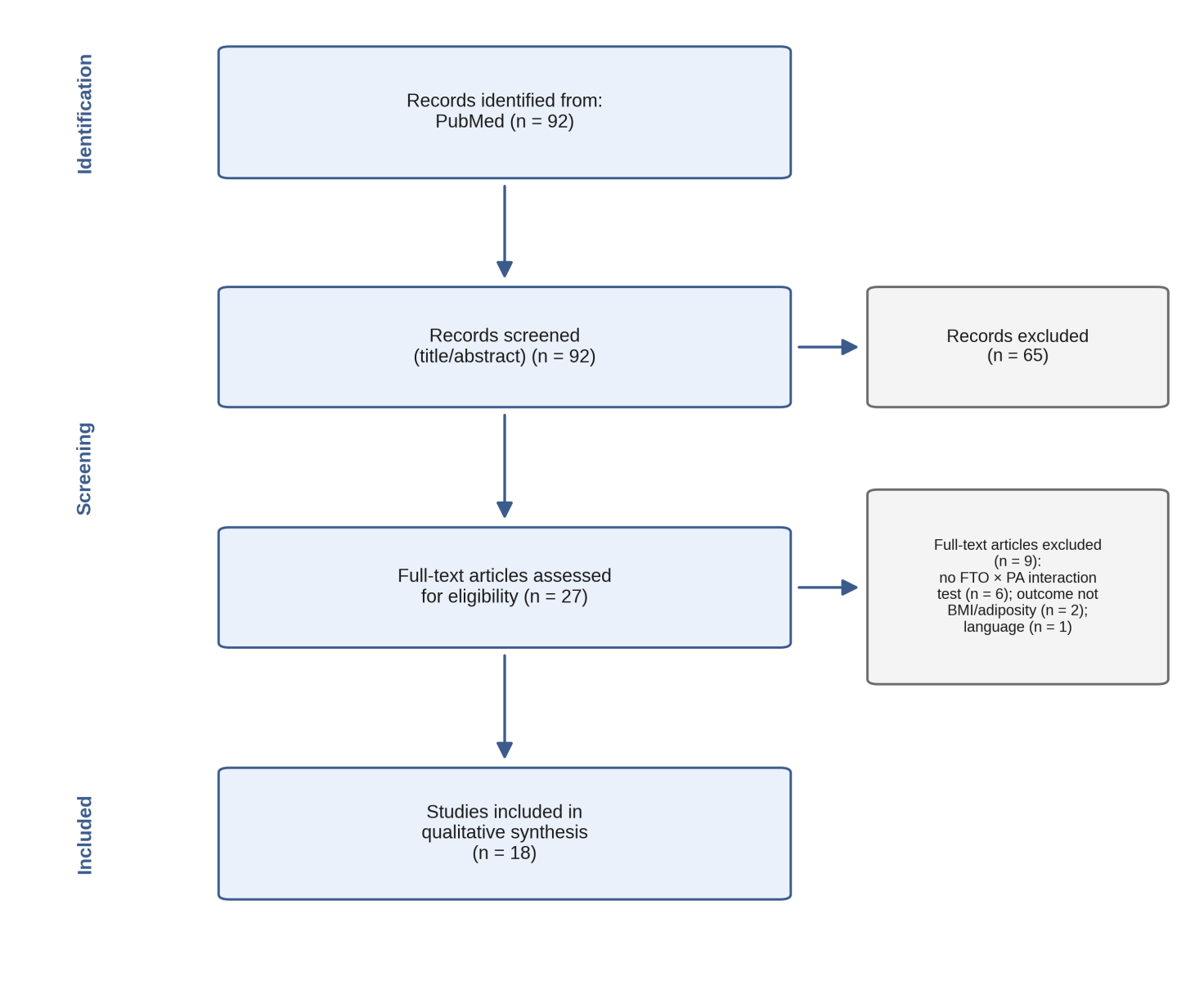
The fat mass and obesity-associated (FTO) gene is the strongest common genetic determinant of body mass index (BMI), and physical activity (PA) has been proposed to attenuate its effect. Evidence published since 2021 has not been systematically synthesized. This systematic review summarizes recent human evidence (January 2021 to December 2026) on the interaction between FTO variants and PA on BMI and related adiposity outcomes. PubMed was searched on 2 September 2026 using a sensitive three-block strategy combining FTO, PA, and BMI terms. Eligible studies were human observational or interventional studies that formally tested an FTO × PA interaction on BMI or adiposity. Screening, data extraction, and quality assessment with a simplified Newcastle-Ottawa scale were performed, and findings were synthesized qualitatively following PRISMA 2020. Of 92 records identified, 18 studies met the eligibility criteria (sample sizes 16-20,906; eight cross-sectional, three cohort, two case-control, and five interventional studies). Eleven studies (61%) reported a significant attenuating interaction, whereby higher PA or structured exercise reduced the effect of FTO risk alleles on adiposity (for example, a 47% attenuation in Danish adults and an approximately two-fold lower obesity risk in physically active Korean risk-allele carriers), whereas seven studies, mostly small or selected samples, reported null interactions. In conclusion, recent evidence generally supports that higher PA attenuates FTO-associated adiposity, but heterogeneity in PA measurement, genotyped variants, and populations, together with a preponderance of cross-sectional designs, tempers certainty (low-to-moderate on a GRADE-style assessment).
Show more
Read Article PDF
Cite
Research Article Open Access
The Impact of Psychological Stress on Obesity Risk in Women: The Roles of Emotional Eating and Sleep Quality
Obesity in women is a serious global public health challenge closely linked to chronic psychological stress. The female hypothalamic-pituitary-adrenal (HPA) axis exhibits heightened sensitivity, predisposing women to unhealthy behaviors under stress. However, existing studies have examined individual behavioral pathways in isolation without integrating emotional eating and sleep disturbances into a unified framework. This narrative review searched PubMed, Google Scholar, and other databases for high-quality population-based studies published between 2020 and 2025. It examines gaps in the existing research on the multiple behavioral mechanisms through which stress may contribute to obesity in women, with a focus on the independent and combined mediating effects of three behavioral categories. Research confirms that chronic stress elevates cortisol levels, induces emotional instability and behavioral patterns such as emotional overeating and poor sleep, thereby increasing women's risk of weight gain; this behavioral pathway exhibits significant gender differences. Most existing evidence consists of cross-sectional data, with a lack of studies specific to women across their life stages. This review provides insights into combined behavioral interventions for the prevention and control of obesity in women and suggests directions for future epidemiological research.
Show more
Read Article PDF
Cite