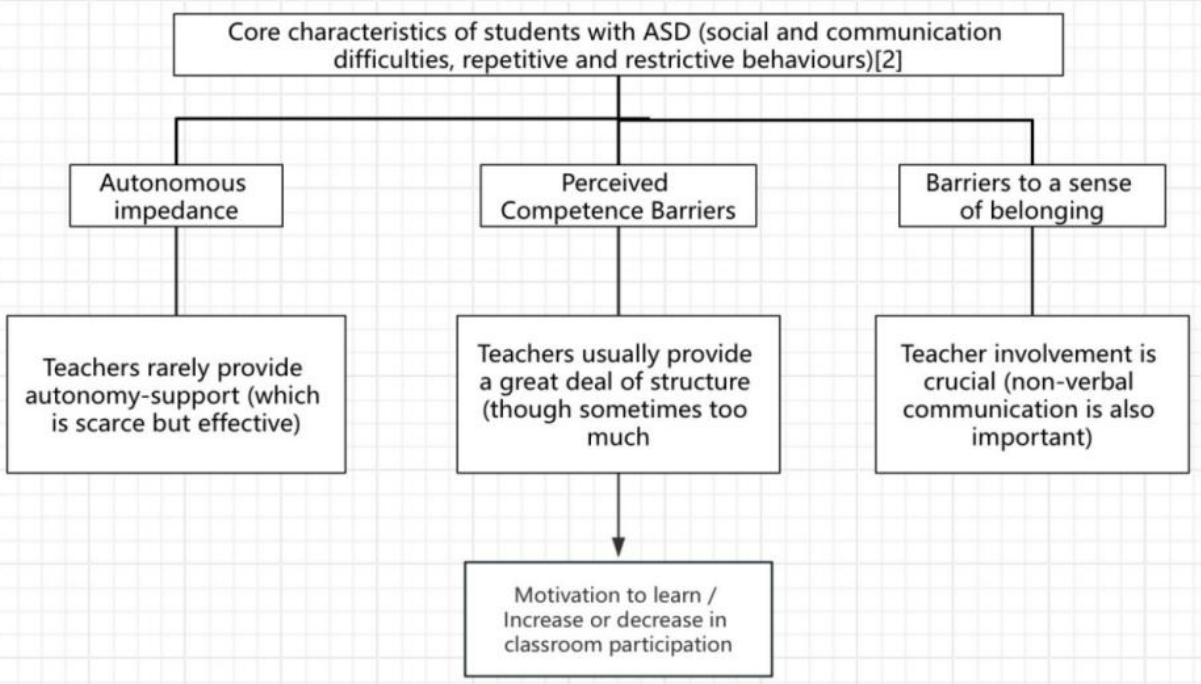
Students with Autism Spectrum Disorder (ASD) generally exhibit lower levels of learning motivation in mainstream classrooms than their peers; however, the relationship between the basic psychological needs of ASD students and their learning motivation remains under-researched. Based on Self-Determination Theory, this paper theoretically analyzes how autonomy, competence, and relatedness influence learning motivation in ASD students. The theoretical analysis indicates that teachers’ need-supporting behaviors are unevenly distributed in inclusive classrooms, where autonomy support is scarce yet effective. The three mediation pathways are as follows: ASD’s executive function difficulties lead to autonomy frustration, subsequently reducing learning motivation; ASD’s limited cognitive flexibility and executive function difficulties cause competence frustration, thereby diminishing learning motivation; and social communication difficulties in students with ASD lead to belonging frustration, thereby reducing learning motivation. A sense of belonging serves as the foundation for autonomy and competence to function, with potential compensatory effects among the three needs. This paper proposes a theoretical mediation model of transmission from ASD characteristics to need impediments and subsequent changes in learning motivation, thereby providing practical guidance for teachers in inclusive education.