Articles in this Volume

Research Article Open Access
Parental Shame and Guilt Induction as Predictors of Adolescent Aggression: A Narrative Review
This narrative review integrates existing studies to show that it is more feasible to understand how parental induction of shame and guilt affects the behavior of adolescents and young adults in different stages in their development. According to the above, this review will introduce the psychological path of self-assessment, responsibility attribution and defense. Also, the culture and society have been shaping the direction of these pathways. Overall, it can be seen that the aggression of adolescents is not caused by negative emotions; rather, it is a defensive coping mechanism resulting from a loss of self-esteem after shame induction by parents, which also leads to a deviation in the sense of responsibility. At the same time, in terms of behavior and adaptation, guilt induction may also be a factor that induces defense mechanisms of children; however, it can also motivate empathy and prosocial behavior out of a need to correct behavior. Finally, this review has established the theoretical boundaries of shame, adaptive guilt and maladaptive guilt; it has put forward an operational framework for family parenting and interventions in school education, and put forward the main directions of future longitudinal studies.
Show more
Read Article PDF
Cite
Research Article Open Access
Application of the Principle of Technological Neutrality to the Ethical Evaluation System of Lawyers Using AI
Technological neutrality is when ethical rules do not discriminate among technology and regulate behaviour, outcomes and risks. AI tools such as SRL applications have become more common in legal research, drafting, due diligence, discovery and document management, creating ethical issues like hallucination, bias, lack of explainability and confidentiality, etc. The literature review in this research points to supporting perspectives that focus on current professional responsibilities and the historical context of robotics, as well as conflicting perspectives that raise concerns about AI-related risks. This is a systematic review study based on articles, law cases, ABA advisory opinions and law review articles. Thematic analysis was used to organize the findings into themes to aid in understanding. The results indicate that technological neutrality will future proof legal ethics, maintain the accountability of lawyers, foster innovation, and that the interests of clients can be protected. The discussion suggests that there is a space for AI-specific protection, but not an alternative to neutrality. Finally, the conclusion states that the ethical assessment should not lay at the heart of the technology but at the heart of lawyers' competence, their supervision, and their responsible usage of AI.
Show more
Read Article PDF
Cite
Research Article Open Access
A Study on the Imbalance of Public Ethical Responsibilities in the Protection of the Rights and Interests of New Employment Groups
Article thumbnail
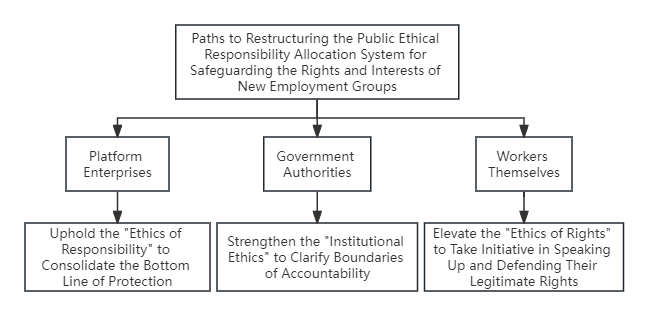
In recent years, the digital economy has flourished, giving rise to many new industries and new occupations, which have spawned a large-scale group of new employment forms. Due to its characteristics of "flexible employment" and "cooperative relationship," the field of new employment forms faces prominent problems such as lack of stable social security, high occupational injury risks, and obstructed channels for rights protection appeals, becoming one of the social pain points. This reflects the imbalance in the allocation of public ethical responsibilities among various subjects. This paper systematically analyzes the characteristics of the imbalance in the allocation of public ethical responsibilities among platform enterprises, government departments, and practitioners, and proposes the construction of a tripartite collaborative responsibility community of "platform self-discipline, government regulation, and worker participation" to achieve a balance between platform economic development and the protection of workers' dignity, thereby providing theoretical reference and decision-making basis for the protection of the rights and interests of workers in new employment forms.
Show more
Read Article PDF
Cite
Research Article Open Access
International Education Assistance from a Chinese Perspective: Normative Reframing, Policy Instruments, and Governance Tensions
International education assistance is becoming a more plural field in which emerging development partners, multilateral organizations, recipient governments, universities, and firms interact. China is increasingly visible in this field, yet its engagement is often interpreted either as distinctive South-South cooperation or as geopolitical influence. This article examines how Chinese policy discourse reframes education assistance, how this perspective is translated into policy instruments, and what governance tensions arise in implementation. Based on qualitative analysis of Chinese and multilateral policy documents issued between 2014 and 2025, supplemented by peer-reviewed research, the study develops a framework of resource transfer, capability formation, and institutional co-production. China's approach combines commitments to mutual benefit, recipient demand, non-conditionality, and autonomous development with infrastructure, scholarships, professional training, vocational education, digital resources, and multilateral trust funds. However, resource asymmetries, fragmented coordination, uneven localization, and limited outcome data constrain the transition from project delivery to locally owned system strengthening. China's contribution therefore lies less in offering a complete alternative aid model than in broadening the repertoire of international education cooperation.
Show more
Read Article PDF
Cite