Articles in this Volume

Research Article Open Access
Information Compensation Perspective: Digital Translation Design Practice of Song Dynasty Book Illustrations
Article thumbnail
Under the background of cultural digital strategy and media change, traditional Song Dynasty book illustrations face problems. They leave paper reading environment. People cannot understand their stories well. Their guiding function does not work well. This paper takes Song Dynasty book illustrations as research object. It wants to keep the original text meaning. It uses design to help images show narrative guiding function in digital environment. This study uses the view of "information compensation". It builds a practice process. The process includes: text narrative structure analysis, style limited visual creation, simple dynamic presentation. This paper studies the specific ways and limits of digital presentation of Song Dynasty book illustrations. It hopes to provide practical reference for digital translation of ancient book images and spread of cultural heritage. The reference respects traditional aesthetics and fits modern digital cognitive habits.
Show more
Read Article PDF
Cite
Research Article Open Access
A Study on the Effects and Mechanisms of Plyometric Training on Lower Limb Muscle Strength and Agility of College Students in Vocational Colleges
Objective: To explore the improvement effects of plyometric training on lower limb muscle strength and agility of college students in vocational colleges, analyze the internal physiological mechanism and the synergistic correlation between the two, construct a standardized plyometric training scheme suitable for this specific group, and provide high-quality empirical evidence and practical guidance for the targeted development of lower limb physical training in vocational colleges. Methods: Sixty freshmen male students without systematic physical training foundation and no history of sports injury from the School of Computer Science, Guangdong Vocational and Technical University of Business and Technology were selected as research subjects, and divided into an intervention group (30 people) and a control group (30 people) by random number table method. The intervention group received 16 weeks of lower limb special plyometric training (twice a week, 30-40 minutes each time), and the control group received conventional physical training with the same frequency and duration. Results: (1) After training, all indicators of lower limb muscle strength in both groups were significantly improved compared with those before training (P<0.01), but the improvement range of the intervention group was significantly higher than that of the control group (P<0.05). The improvement rates of 1RM squat, vertical jump height and squat jump power in the intervention group were 28.45%, 22.17% and 25.32% respectively, while those in the control group were 10.36%, 6.78% and 8.92% respectively. (2) After training, the completion time of all lower limb agility indicators in both groups was significantly shortened compared with that before training (P<0.01), and the optimization effect of the intervention group was significantly better than that of the control group (P<0.05). The shortening rates of 5-10-5 agility run, T-run and hexagon jump in the intervention group were 14.23%, 13.56% and 15.78% respectively, while those in the control group were 4.12%, 3.89% and 4.35% respectively. (3) After training, the RMS values of electromyographic signals of quadriceps femoris and gastrocnemius in both groups were significantly increased compared with those before training (P<0.01), and the improvement rates of the intervention group (48.65%, 49.32%) were significantly higher than those of the control group (19.45%, 21.18%) (P<0.05). (4) Pearson correlation analysis showed that the change values of neuromuscular activation indicators in the intervention group were significantly positively correlated with the change values of lower limb muscle strength and agility indicators (r=0.582-0.713, P<0.01); the improvement values of lower limb muscle explosive power (vertical jump height, squat jump power) were significantly positively correlated with the improvement values of agility indicators (r=0.654-0.731, P<0.01). Conclusion: Plyometric training can significantly improve the lower limb muscle strength and agility of college students in vocational colleges, and the effect is better than conventional physical training; its core mechanism is closely related to the improvement of neuromuscular activation efficiency and the enhancement of skeletal muscle stretch reflex function; the improvement of lower limb muscle explosive power is an important support for agility optimization, and there is a synergistic improvement effect between the two. The training scheme constructed in this study is suitable for the physiological characteristics of this group and campus training scenarios, and can be directly applied to physical education teaching and after-school physical training in this university, providing scientific support for the precise optimization of lower limb physical training for college students of specific majors in vocational colleges, and also providing a reference paradigm for similar studies.
Show more
Read Article PDF
Cite
Research Article Open Access
The Representation, Attribution and Solutions to the "Banality of Evil" in Education from the Perspective of Psychopolitics
The "banality of evil" proposed by Hannah Arendt refers to the evil that eliminates one's own thinking, unconditionally obeys orders, and abandons the right of personal judgment. This evil is spreading in the educational field, manifested in the triple representations of "thoughtlessness", "depersonalization" and "standardization". To deeply analyze its generation logic from the perspective of social formation, this paper introduces Byung-Chul Han's "psychopolitics" as a new theoretical framework to reveal the deep-seated mechanism behind it, and attempts to put forward the breakthrough paths of awakening "tiredness", pursuing "the Other" and returning to "listening". It aims to transcend the reproduction of the "banality of evil" in the educational field and ultimately point to an educational possibility that enables people to truly become human beings.
Show more
Read Article PDF
Cite
Research Article Open Access
Opportunities, Challenges and Countermeasures for Women's Development in the Age of Artificial Intelligence From the Perspective of Rights Protection
The right to development is an inherent part of human rights. As the institutional expression of the principle of gender equality in the field of development, women's right to development derives its legitimacy from the human dignity in natural law, the normative confirmation in positive law and the pursuit of substantive justice in social law. From the perspective of rights protection, this paper explores the realization of women's right to development in the age of artificial intelligence, pointing out that the right to development is the core human rights support for women's all-round and free development. At the same time, artificial intelligence technology has brought multiple opportunities for women's development: it has eliminated the physical prerequisites of the traditional gender division of labor, expanded the space for women's employment and entrepreneurship in the economic field, lowered the threshold for participation in the field of social participation, and further promoted the in-depth improvement of women's right to cultural expression in the cultural field. However, technology is not value-neutral. Artificial intelligence embedded with patriarchal prejudices and capital logic has also exposed women to new rights crises such as structural employment inequality, the solidification of gender images by algorithmic discipline, and the erosion of subjectivity by technological abuse. The causes stem from the digital reproduction of the patriarchal social structure, the influence of commercial capital, and the digital suppression of women's professional self-efficacy. In response, this paper proposes approaches such as innovating employment forms, improving institutional guarantees, and enhancing women's voice in artificial intelligence governance, aiming to protect women's right to development and promote gender equality and the progress of social civilization.
Show more
Read Article PDF
Cite
Research Article Open Access
Research on Early Warning and Group Intervention of College Students' Academic Emotion Crisis from the Perspective of Social and Emotional Learning
Article thumbnail
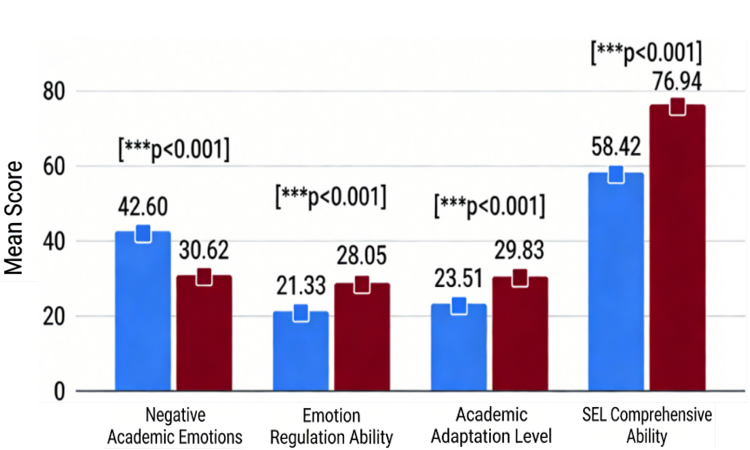
Under the background of the popularization of higher education, college students' emotional crises such as academic anxiety, burnout and weariness of learning continue to occur frequently. Traditional interventions have problems such as delayed response, fragmentation and insufficient accuracy. Based on the five core competencies of Social and Emotional Learning (SEL), this study constructs an early identification and graded early warning mechanism for academic emotion crisis. Using mixed research methods, this study conducts an empirical analysis of 603 students in Y University, an application-oriented undergraduate college in Guangdong Province, and implements 8-week structured group intervention. The results show that the recognition accuracy of the SEL early warning model reaches 89.7%; after the intervention, negative academic emotions decrease by 28.3%, emotional regulation ability and academic adaptation level increase by 31.5% and 26.7% respectively, and the effect is stable for a long time. The study forms an integrated mode of "early warning-screening-intervention-tracking", which can provide a practical path for the pre-prevention and control of academic emotion crisis and the standardization of mental health education in colleges and universities.
Show more
Read Article PDF
Cite