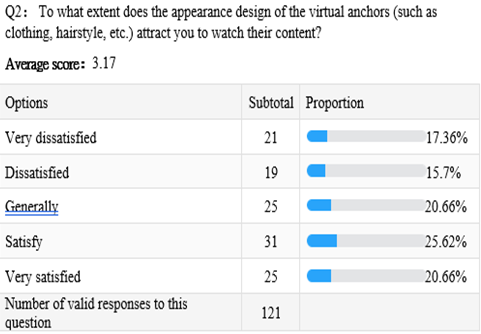
This study investigates the psychological projections of viewers onto virtual anchors and their resulting attachment behaviors. With the increasing popularity of live-streaming platforms, virtual anchors have become prominent digital figures that interact with viewers in real time. This research investigates how emotional attachment to virtual entities is formed through psychological projection, which involves, attributing one's feelings or qualities to others. A quantitative approach was employed for data collection, involving a questionnaire administered to 121 respondents. The findings indicate that appearance, personality, and interaction frequency significantly influence audience attachment. Viewers tend to project desired traits onto virtual anchors and form emotional attachments that can be sustained through repeated interactions. Interestingly, even passive viewers who are less attached to the programs reported strong attachments, showing that projection and other factors contribute to forming this attachment. The study reveals that while emotional reliance on virtual anchors is present, it remains at a moderate level, with content style being an important factor for viewer dependency. These insights provide a deeper understanding of virtual relationships and offer valuable implications for virtual content design and development that add to the influences of digital media engagement