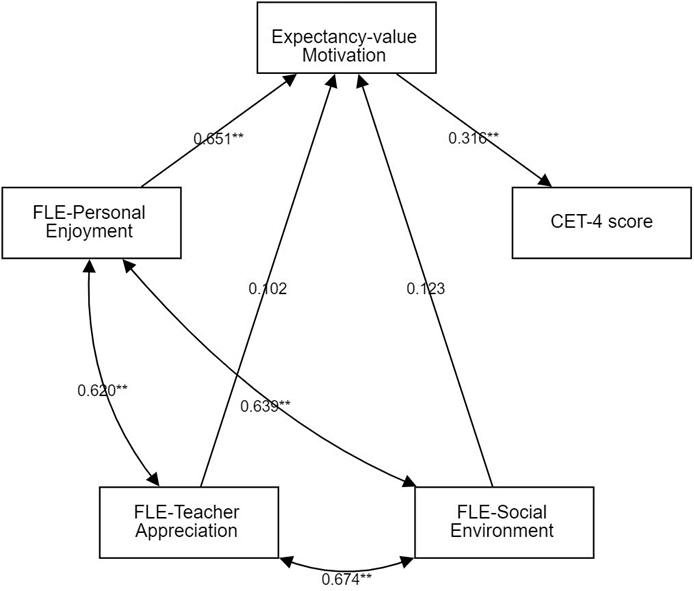
This study is to examine correlations between foreign language enjoyment (FLE), expectancy-value enjoyment, and English competence of Chinese university students. A questionnaire was used to collect information from 74 Chinese non-English major college students about their FLE, expectancy-value motivation, and their English competence. According to the findings, the mean FLE of Chinese university students is 5.491, showing moderate to high levels of FLE, and the teacher factor is the highest scoring dimension (the mean is 5.982). The teacher appreciation and social environment (the mean is 5.428) are more prominent than the personal enjoyment factor (the mean is 5.065). Besides, in the expectancy-value motivation dimension, achievement value and utility value are most prominent. As far as the relationship between FLE and expectancy-value motivation of Chinese university students is concerned, the results show a significant positive relationship between the two (except for cost value), thus indicating that FLE increases with motivation. Specifically, FLE has the most significant positive relationship with intrinsic value and expectancy beliefs. The Amos path analysis concludes that in the FLE dimension, personal enjoyment factors can indirectly affect students' English competence in addition to directly positively correlating with expectancy-value motivation, which highlights the important influence of personal factors on foreign language learning.