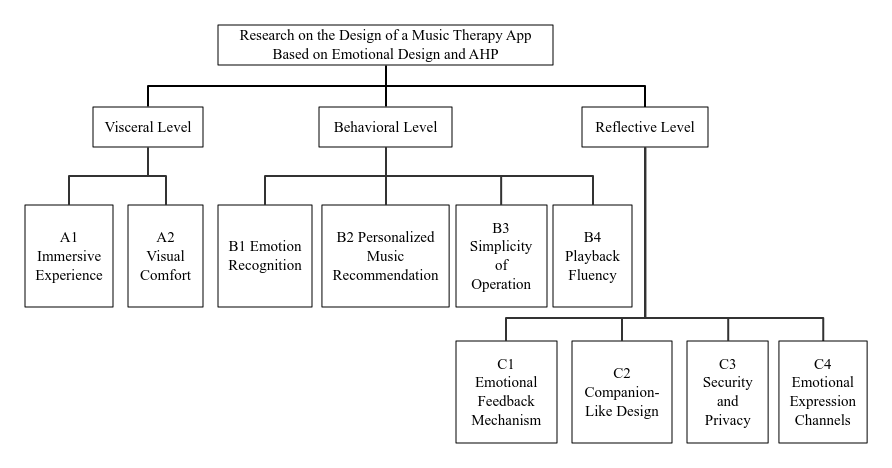
Amid the quickening rhythms of contemporary life and the steady escalation of stress exposure, concerns surrounding psychological well-being have become increasingly visible. Within this context, music therapy has received increasing attention from both researchers and practitioners because it focuses on emotional regulation. However, current music therapy applications still have some clear limitations. In particular, they often do not provide a satisfying emotional experience for users or fully meet their individual needs. To address these issues, this paper applies emotional design theory and combines it with the Analytic Hierarchy Process (AHP). Based on this approach, it develops a research framework for designing music therapy applications that better support users' emotional needs. First, this study reviews previous research on emotional design theory and the AHP method through a literature review. Based on this review, the overall research process is established. Next, user research is carried out through interviews, questionnaires, and competitor analysis. These methods help identify the main user needs in different music therapy scenarios. Finally, an AHP model is developed to analyze the importance of these needs and determine their priority.