


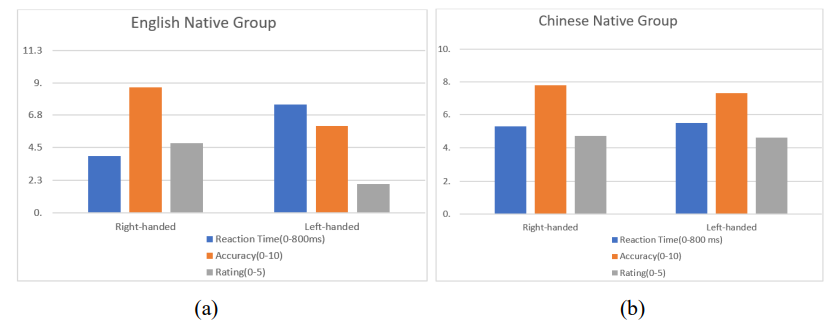
This study investigates the interaction between cultural-linguistic environment and handedness in shaping spatial-valence associations, addressing a key debate in embodied cognition regarding the relative influence of body-specific experience (nature) versus cultural-linguistic context (nurture). We compared English monolinguals, whose language reinforces “right = good, left = bad” metaphors, with Chinese monolinguals, whose language lacks strong spatial-valence connotations. Using a 2×2 between-subjects design (culture × handedness), we measured reaction times, accuracy, and subjective preferences in a spatial-emotional matching task. Results indicate that while right-handed English speakers exhibited stronger spatial-affective congruence consistent with the Body-Specificity Hypothesis, Chinese speakers would show attenuated effects, suggesting that cultural-linguistic context can modulate body-based preferences. These findings highlight the nuanced role of culture in embodied cognition and imply that psychological tools relying on spatial-valence mappings should account for cultural and handedness differences. This study contributes to the theoretical understanding of how nature and nurture interact in cognitive processing and offers practical insights for cross-cultural psychological assessment and intervention.